Projects / AI Visibility Checker — 夏裕科技In production
Does AI recommend your business?
Your customers now ask ChatGPT, Perplexity, Gemini and Claude who to hire. The AI Visibility Checker asks those same questions, in English and 中文, and counts whether your business gets named, who gets named instead, and which websites the AI trusted for its answer.
In production · runs every month for our clients, inside their dashboard · self-serve version next
Your customers are asking AI who to hire.
More people now skip the search results and ask an AI assistant: “Who's the best accountant in San Diego?” The assistant replies with two or three names. If yours isn't one of them, that customer never reaches your website, however good it is.
Most businesses don't know what these assistants say about them. Each engine searches its own way, the answers change from day to day, and English and Chinese results differ. So we built a tool that measures it.
Asking ChatGPT yourself won't show you what customers see.
It's the first thing most owners try. But one chat can't measure what your customers are told, for four reasons.
- Different question
- You ask “Is Acme Accounting any good?” Your customers ask “Who's the best accountant in San Diego?” and never say your name. Once a business is named in the question, AI almost always finds something nice to say. The real test is whether it names you when nobody else does.
- AI can't report on itself
- Ask “Would you recommend my business?” and the AI guesses what it might tell someone else. It isn't checking anything, and its guesses tend to be polite.
- One answer is one sample
- Ask the same question twice and you can get different names. One reply tells you very little, so we run each question several times and report how often you're named.
- Tailored to you
- AI adjusts its replies to your location, your past chats and what it remembers about you. And you're checking one engine, while your customers use four.
| Asking AI yourself | The AI Visibility Checker | |
|---|---|---|
| Questions | One, usually with your name in it | 15 real customer questions, in English and 中文, without your name |
| Engines | One | ChatGPT, Perplexity, Gemini and Claude |
| Runs | Once | Several per question, reported as how often you're named |
| Context | Shaped by your location, history and memory | Fresh sessions with no personal history |
| Location | Wherever you happen to be | Asked as if from the cities your customers are in |
| Competitors | Not shown | Who gets named instead of you, and how often |
| Sources | Usually hidden | The sites AI cited, and whether you're listed on them |
| Over time | Nothing to compare against | The same questions every month, so you see the trend |
How it works.
- Ask like a customer15 real customer questions in English and 中文, sent to ChatGPT, Perplexity, Gemini and Claude with live web search, from your customers' cities.
- Read every answerWas your business named? In what position? Who was named instead, and which websites did the AI cite?
- Check your websiteStructured data, llms.txt, whether AI crawlers are blocked, page speed: what AI engines rely on to understand and trust a site.
- Repeat monthlySame questions, same engines, same cities, so each month's numbers compare with the last.
What you see in the dashboard.
Real views from a client's dashboard: WU LAW INTL PLLC, a Taipei law firm handling US–Taiwan inheritance. First check October 26, 2026. Shared with the client's consent; peer names are blurred.
Named and cited, check by check
How many of the 45 answers name the firm, how many cite its site, and the split per assistant. The first check found the site cited in 0 answers; four days and a round of fixes later, 26.
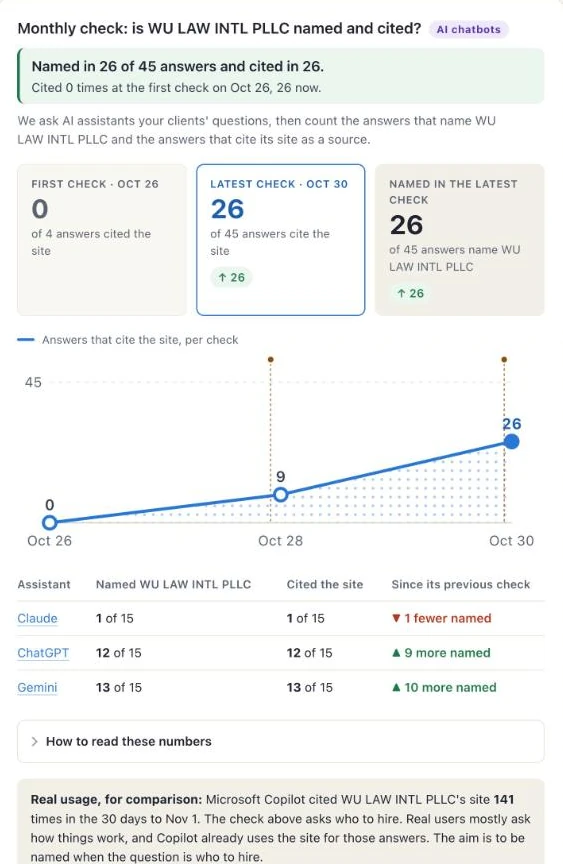
Monthly check panel. October 26 → October 30, 2026.
Head to head with peers
For each competitor you choose to track: how often AI names you versus them, and how many of each side's pages get cited. The names are yours to pick; here they're blurred.
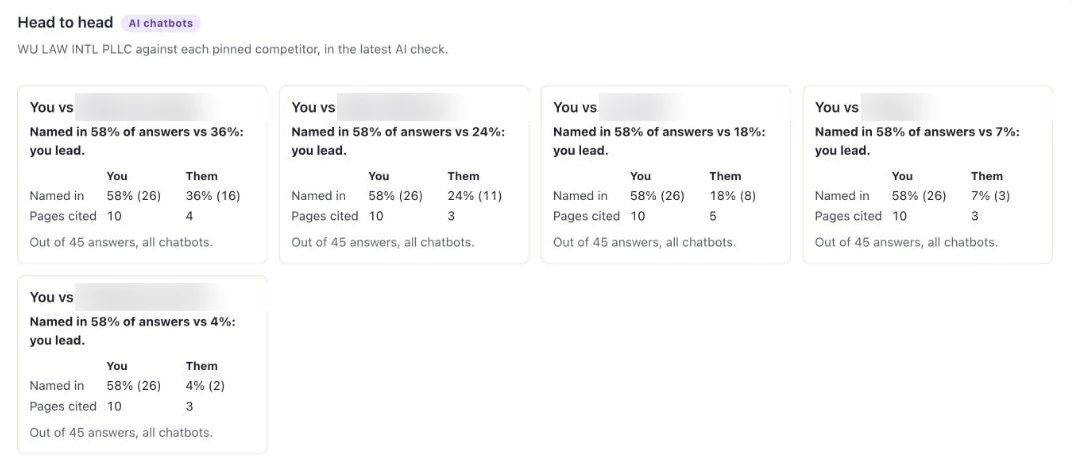
Head-to-head panel, October 30 check. Peer names blurred.
Also in every report
- Every answer
- Word for word, so you can read what each AI said, and which questions it got wrong.
- Sources AI trusts
- The directories, review sites and articles it cited, and whether you're listed on them. That's where you need to appear.
- Topic map
- For each topic, which businesses AI ties together, and which topics you're not yet tied to.
- Fixes, ranked
- Specific changes to your site and listings, most important first, each turned into a draft you approve before it goes live.
- By language and city
- English and Chinese results side by side, from the cities your customers are in. Many businesses show up in one and vanish in the other.
Built and run in-house.
Python and LangGraph, calling each engine's own web-search API so the answers match what real users see. Every answer is saved, every run logs its cost, and the scoring is checked against businesses whose results we already know.
It has run in production since October 2026 as part of our tech marketing service: the monthly check feeds the to-do list, and the results live in each client's dashboard. A self-serve version, where you enter your business and get the report by email, is the next step.
Want to know what AI says about you?
The first check is free: your business name, website, where your customers are, and we send you the report. We reply within 1–2 business days.
In English or 中文. We listen first; if we're not a fit, we'll say so. No sales pitch.